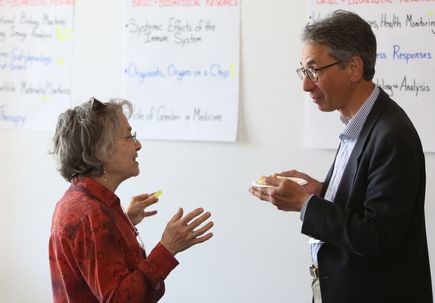
In a daylong summit last month at Western Oregon University in Monmouth, about 90 UO and OHSU researchers from a variety of disciplines brainstormed possible collaborations. Both institutions are currently developing major new research facilities thanks to unprecedented gifts from the same benefactor.
Katharine Zuckerman, M.D., M.P.H., splits her time seeing young patients at OHSU Doernbecher Children’s Hospital and researching the relationships between health care disparities and early childhood development.
Data suggests the most effective interventions for children diagnosed with autism spectrum disorder, or ASD, should access therapies offered at school and in health care settings.
Sarah Feldstein Ewing, Ph.D. is researching ways to improve treatment approaches tailored specifically for teens by analyzing how adolescent brains respond to therapist language.
Kevin Wright, Ph.D. is an assistant professor running his own laboratory in OHSU’s Vollum Institute, where he applies his natural curiosity toward solving one of the most formidable puzzles in science and medicine: how the nervous system works.
Maria Isabel Rodriguez, M.D., M.P.H., cares for patients at the OHSU Center for Women’s Health and finds satisfaction in supporting women, particularly teens, through important or challenging life events. As with many faculty members at OHSU, her clinical work drives her research.
Gail Mandel, Ph.D., is helping to develop a gene therapy technique to repair a mutation on the X chromosome which causes the neurological disease Rett syndrome.
Kerri Winters-Stone, Ph.D., researches the use of physical activity to prevent and manage chronic disease. Her studies have shown that cancer survivors can benefit from exercise that reverses treatment-related side effects and symptoms.
On any given day, you can find Jeffrey Jensen, M.D., M.P.H., caring for patients, writing NIH grants, teaching medical students or looking at the latest test results in his lab at the Oregon National Primate Research Center. But what gets him up every morning is his commitment to making birth control safer and more effective for women around the world.