Mitalipov: Mitochondrial replacement therapy (2016)
Oregon Health & Science University provides a curated selection of high-resolution photos, video footage, b-roll and graphics for news organizations and media coverage related to OHSU stories. Commercial use is prohibited without prior written consent.
Media usage guidelines
- Photos and video should be credited as “OHSU/Photographer name.”
- Metadata includes captions and usage restrictions.
- Color correction and cropping are allowed. The content or nature of the photo may not be altered.
Questions or requests: Please contact OHSU Strategic Communications at news@ohsu.edu or 503-494-8231.
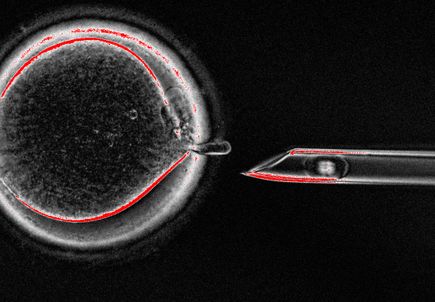
Mitochondrial replacement therapy
A pipette pulls out the nuclear genetic material from an unfertilized egg –a key step in mitochondrial replacement therapy. The nucleus, or spindle, is visible in the pipette. (OHSU)
ST in human oocytes
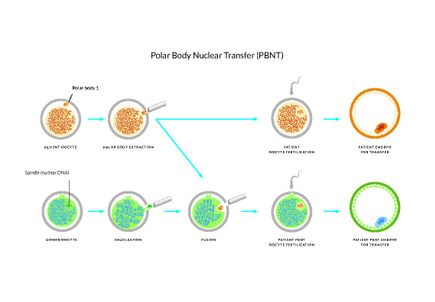
Shoukhrat Mitalipov's spindle-transfer technique. (OHSU)

Shoukhrat Mitalipov, Ph.D.
Shoukhrat Mitalipov, Ph.D., director of the OHSU Center for Embryonic Cell and Gene Therapy. (OHSU/Jeffrey Ball)

Hong Ma, M.D., Ph.D.
Hong Ma, M.D., Ph.D., staff scientist responsible for the management of the stem cell and molecular biology lab within OHSU’s Center for Embryonic Cell and Gene Therapy. (OHSU/Jeffrey Ball)
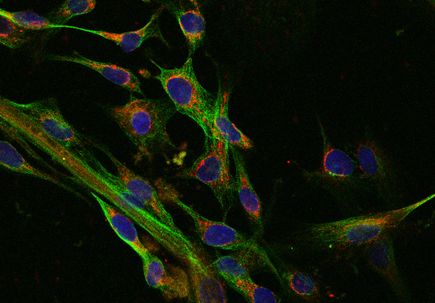
Mitochondria
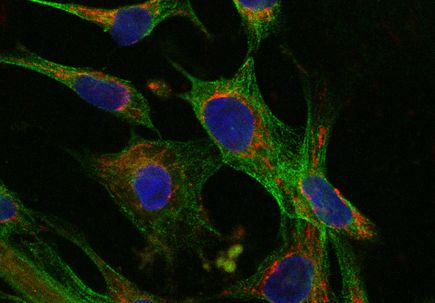
Confocal microscopy image of Dr. Shoukhrat Mitalipov's work with human fibroblasts derived from —SCNT-ESCs. Nuclei are show in blue; mitochondria in red; and microtubules appear in green. (OHSU)
Mitochondria
A magnified section of a confocal microscopy image from Dr. Shoukhrat Mitalipov's work, showing human fibroblasts derived from —SCNT-ESCs. Nuclei are show in blue; mitochondria in red; and microtubules appear in green. (OHSU)
Mutant-iPSCs
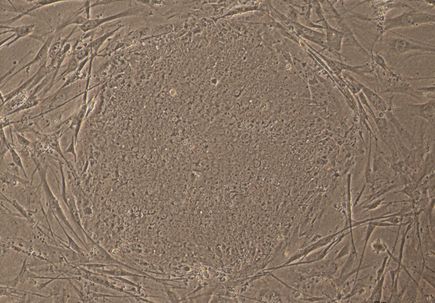
Image from Dr. Shoukhrat Mitalipov's work, showing a human iPS cell colony. (OHSU)
- Latest Stories
- Popular